
Why 62% Fibre Coverage Does Not Mean Mass FTTH in Germany: The Gap Between Homes Passed, Homes Connected and Active Connections
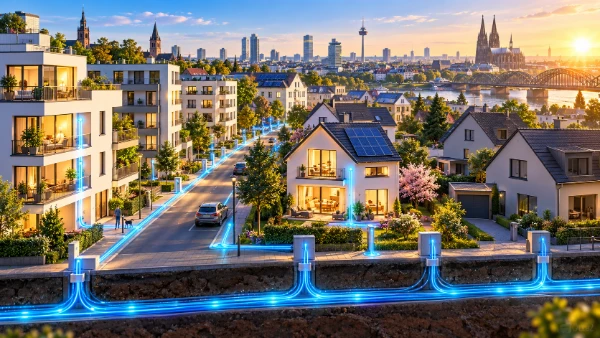
Germany’s fibre build-out has accelerated enough for a headline figure that sounds close to mass availability: 62.0% coverage by mid-2026. Yet the figure in the BREKO Market Analysis 2026 refers to Homes Passed — 28.7 million homes and business locations where fibre infrastructure has reached the immediate vicinity of the property boundary — rather than 28.7 million premises already using fibre all the way to the home. At the same reporting point, the Homes Connected rate was 29.8%, equal to 13.8 million premises, while 7.9 million fibre connections were actively used. That gap is the central issue in Germany’s fibre story. A cable in the street, a completed building connection, fibre inside a flat and a paid internet service are four different stages. Germany has become much better at reaching streets and properties, but converting that reach into completed and active FTTH remains a slower process.
What Germany’s 62% Fibre Coverage Actually Measures
The 62.0% figure comes from BREKO’s 2026 market analysis, conducted by IW Consult and covering the market up to 30 June 2026. It represents 28.7 million homes and business locations counted as Homes Passed, an increase of 9.2 percentage points within a year. This is substantial progress in physical network expansion, and it shows that fibre is moving into far more German streets than it was only a few years ago. The same study, however, reports a connection rate of just 29.8%. In other words, the national rollout is advancing much faster at the stage where fibre reaches the vicinity of a property than at the stage where the line is actually taken through the property and into the building. Treating both figures as the same form of “coverage” gives a misleading impression of how much fibre is ready for immediate household use.
The Bundesnetzagentur uses a similarly important distinction. Under its definition, Homes Passed can include a property where a dedicated duct or fibre cable runs close to the boundary and where an active building connection could technically be created on normal commercial terms in a short period. Additional investment may still be necessary. Homes Connected goes further: the fibre has actually been brought to the end-customer premises, although the service may still be inactive. Homes Activated means that the line is in use. These definitions are not minor statistical details. They describe different amounts of work, different costs and different levels of customer readiness. A street can therefore appear well served on a national fibre map even when a large share of the buildings along that street still need the final physical connection.
There is another distinction that matters: FTTH is not the same as every FTTB/H connection reported in market totals. FTTH takes fibre to the individual home or flat, while FTTB takes fibre to the building and may use another type of cabling for the final section inside. Germany’s regulator often reports the two together when describing fibre activity, so a headline number for “active fibre connections” should not automatically be read as active FTTH. The European Commission’s 2026 Digital Decade assessment underlines the broader gap. Using 2025 reference data and its own FTTP methodology, it recorded German FTTP coverage at 44.0%, compared with an EU average of 74.1%. That figure is not directly interchangeable with BREKO’s 62% Homes Passed rate because the date, reporting scope and methodology differ, but both sources show that Germany is still some distance from universal fibre-to-premises availability.
Homes Passed, Homes Connected and Homes Activated Are Three Different Steps
The simplest way to understand the market is as a funnel. Homes Passed is the widest stage: fibre has reached the local area closely enough for a property to be connectable. Homes Connected is narrower: the physical line has been taken to the building or premises. Homes Activated is narrower again: a customer has ordered a service and the connection is actually carrying traffic. BREKO’s mid-2026 figures put those stages at 28.7 million Homes Passed, 13.8 million Homes Connected and 7.9 million active fibre connections. The reported take-up rate was around 27%. This makes clear why the 62% headline cannot be treated as a measure of fibre adoption. It mainly describes the reach of construction work, while the smaller figures describe completed access and actual customer use.
Put another way, only about 48% of the premises counted as Homes Passed in the BREKO data had also reached the Homes Connected stage by mid-2026. Of those already connected, roughly 57% had an active fibre service. These ratios are not separate official targets, but they help show where the losses occur between one stage and the next. The first gap is physical: fibre is nearby but has not yet been brought into the building. The second gap is commercial: the line exists, but no active service has been taken. A country can therefore post a strong annual increase in Homes Passed without seeing the same increase in active fibre customers. That is exactly what Germany’s 2026 figures show: reach expanded quickly, while the conversion of that reach into completed and used connections moved more slowly.
Official 2025 data from the Bundesnetzagentur provide an even clearer view of what “active fibre” means in practice. At the end of 2025 Germany had 6.4 million active FTTB/H connections, up from 5.3 million a year earlier. Of these, about 5.2 million were FTTH and around 1.2 million were FTTB. Fibre represented 16.5% of all active fixed broadband connections, while DSL still accounted for 58.5%. The regulator also counted 7.1 million FTTH premises and 3.3 million FTTB premises in the Homes Connected category, including both active and inactive lines. The later BREKO figure of 7.9 million active fibre connections in mid-2026 shows continued growth, but it should still be understood as a combined fibre measure rather than proof that 7.9 million German households already have pure FTTH to the individual dwelling.
Why the Gap Widens Between the Street and the Home
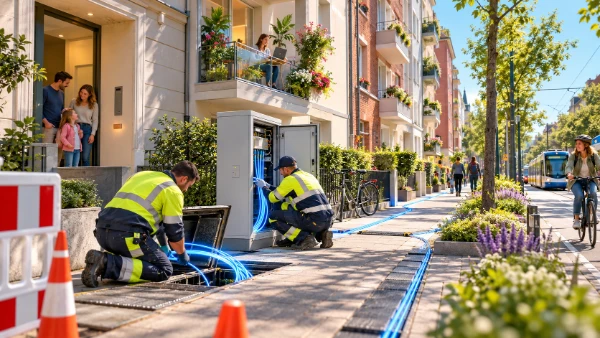
The last few metres are often the most expensive part of the job. BREKO’s 2026 analysis puts the average cost of the drop connection from the street into a building at about €1,950. Network builders can gain scale when they lay ducts and fibre along an entire road, but each individual property then requires a separate connection, construction work, access to private land or the building and, in many cases, coordination with the owner. This changes the economics of the rollout. BREKO reports that operators are increasingly reluctant to connect buildings in advance when there is no customer contract, because the expensive final step may sit unused for years. That helps explain why Homes Passed rose by more than nine percentage points in a year while Homes Connected increased by only 1.2 million premises, slower than the 2.1 million increase recorded in the preceding comparable period.
Apartment buildings add another layer because getting fibre to the basement is not always the end of the work. In a multi-dwelling property, an FTTH service may require fibre to be distributed from a central building entry point to individual flats. The federal Gigabitbüro describes this in-building section as a separate part of the connection process, with fibre running from the house entry through a building distributor to the customer socket in each dwelling. Germany and the EU have started to address this bottleneck. Since 12 February 2026, new buildings and buildings undergoing major permitted renovation generally have to include fibre-ready physical infrastructure and in-building fibre wiring under the Gigabit Infrastructure Act rules. That will make future properties easier to serve, but it does not instantly remove the practical work required in millions of existing buildings.
Germany’s market structure also affects the speed at which a nearby network becomes an active household service. Different operators may build in the same region, while retail providers do not always sell over every fibre network. Open-access arrangements can improve utilisation by allowing more providers to use existing infrastructure instead of relying only on their own lines. BREKO reported in 2026 that 88% of surveyed network operators already used commercial partnerships, mainly through wholesale access arrangements. Even so, network reach alone does not guarantee a broad choice of retail offers at every address. For the end customer, the relevant question is not simply whether fibre passes the property, but whether the building connection is complete, whether an appropriate service can be ordered and whether the in-building route is ready for FTTH.
Demand Is Growing, but Existing Broadband Still Feels Good Enough
Germany’s slow conversion from available fibre to active fibre is not only a construction problem. It is also a customer-choice problem. DSL remains deeply established, and cable networks provide another high-speed alternative in many areas. Bundesnetzagentur figures for the end of 2025 show that 58.5% of active fixed broadband connections still used DSL, compared with 16.5% using FTTB/H. That legacy base reduces the urgency to change, particularly for households whose current service is stable and fast enough for streaming, home working and everyday internet use. Fibre offers more headroom and is the long-term direction of the fixed network, but many households make a purchasing decision based on what they need today rather than on the maximum capacity a connection could provide years from now.
Deloitte’s Broadband Consumer Trends 2026 study gives a concrete measure of that inertia. The survey, based on 2,000 people in Germany, found that 62% agreed with the idea that they did not want to change a fixed connection that was already working well. Satisfaction was high even among users of older access technologies: 81% of broadband users were rather satisfied or very satisfied with their connection, while satisfaction among fibre users reached 87%. The result is a market in which fibre customers are generally pleased with the service once they have it, but a large group of non-fibre customers does not feel an immediate reason to move. That helps explain why infrastructure availability can rise much faster than the number of activated connections.
Price is another practical factor. A 2026 Verivox survey found that 65% of current DSL and cable customers named a good price or attractive offer as a factor that could persuade them to switch to fibre. Higher speed and greater connection stability were each cited by 52%. This suggests that availability by itself is not enough: the offer has to make sense against an existing contract that may already meet the household’s needs. Contract timing can add further delay because customers often wait until a current agreement ends before changing provider or access technology. The demand gap is therefore not evidence that fibre has little value. It shows that a technically superior connection still has to compete on price, convenience, timing and perceived need before Homes Connected becomes Homes Activated.
What Must Change Before Fibre Reach Becomes Mass FTTH Use
The biggest structural change will be the gradual move away from copper. The Bundesnetzagentur states that Germany’s long-term fixed-network demand will ultimately have to be served by pure fibre and that continued operation of the copper network will become uneconomic. As of 2026, however, there is no single nationwide date on which Germany’s DSL network will simply disappear. The regulator has been developing an approach for copper-to-fibre migration, while the timing of the first local switch-offs remains a matter for regulation, market readiness and consumer safeguards. This matters for take-up because running copper and fibre side by side allows customers to remain on DSL even where fibre is already nearby. Migration will become much faster only when local fibre coverage is high enough and users have a clear, workable route from the old network to the new one.
Better use of the fibre that has already been built is just as important as laying more cable. The economic problem is easy to see in the 2026 figures: operators have financed infrastructure past 28.7 million premises, but only 7.9 million active fibre connections are generating customer revenue. That gap makes activation rates important for future investment. BREKO found that 77% of network operators would be willing to invest more if Germany had a binding, rules-based roadmap for the copper-to-fibre transition, while 52% said they would reduce further rollout without such a framework. These figures come from an industry study and should be read as the views of the companies surveyed, not as a neutral forecast. Even so, they show why the next phase of German fibre policy is increasingly about connecting and converting existing coverage rather than celebrating Homes Passed alone.
National averages also hide major regional differences. In mid-2026, BREKO reported Homes Passed coverage of 94.0% in Schleswig-Holstein, 92.5% in Hamburg and 88.9% in Bremen. The connection-rate ranking looked different: Schleswig-Holstein led at 66.7%, followed by Hamburg at 50.0% and Brandenburg at 48.8%. This is a useful reminder that two regions can have similar street-level fibre reach while producing very different numbers of completed building connections. Local building stock, past investment, municipal coordination, operator strategies and customer demand all affect the conversion from reach to use. For households and businesses, a postcode-level or address-level availability check is therefore more meaningful than the national 62% figure when deciding whether FTTH can actually be ordered and installed.
How to Read Germany’s Fibre Numbers Correctly From 2026 Onwards
The first rule is to look for the label behind any percentage. Homes Passed measures network reach near the property. Homes Connected measures completed physical access to the premises. Homes Activated measures a connection that is actually being used. A fourth question is then necessary: is the connection FTTH, with fibre to the individual dwelling, or FTTB, with fibre ending at the building? Reporting periods matter as well. BREKO’s 62% figure refers to mid-2026, while the European Commission’s 44.0% German FTTP figure uses 2025 reference data and a different statistical approach. Both can be valid at the same time. Problems arise when figures from different dates and definitions are placed side by side as though they measured exactly the same thing.
The second rule is to separate rollout success from adoption success. Germany can reasonably claim strong recent progress in civil construction: the Homes Passed rate rose by 9.2 percentage points in a year. It cannot infer from that result that a similar share of households has FTTH installed and active. By mid-2026, the 13.8 million Homes Connected figure was less than half the 28.7 million Homes Passed total, and the 7.9 million active connections were smaller again. The most useful indicators for the next few years will therefore be the growth of Homes Connected, the number of active FTTH rather than only combined FTTB/H, the take-up rate, and the pace at which DSL users actually migrate. Those measures show whether construction is turning into everyday use.
The 62% figure is therefore important, but its meaning is narrower than the headline suggests. It shows that Germany has brought fibre close to a majority of homes and business locations, which is a necessary step towards a fibre-based fixed network. It does not show that most Germans already have fibre entering the building, still less that most have FTTH to the individual home or an active fibre subscription. The more accurate picture in 2026 is a three-stage transition: rapid expansion at street level, a much smaller pool of completed property connections and a smaller group again of paying users. Germany’s fibre challenge is no longer only to build further. It is also to finish the connection, wire the building where needed, make switching commercially attractive and move customers from legacy networks onto the fibre that is already within reach.